
Reading time: 20 min.
Hair transplant and hair-loss conversations are full of acronyms and jargon. This glossary is designed as a companion while you research clinics, compare methods such as FUE vs FUT, and speak with doctors. It explains the main terms you’ll see across hairimplants.net and in credible medical sources (see References: NHS/ISHRS/BAHRS).
If you find this glossary helpful, share it with your hair-loss or transplant research group so more people can understand the language and avoid confusion.
Quick Facts
This glossary is for education only and does not replace a private medical consultation (see References: NHS).
Definitions are simplified on purpose; your surgeon may use slightly different wording based on your case.
Many terms link to in-depth guides so you can go from a quick definition to a detailed explanation.
When in doubt, ask your doctor to explain how each term applies to you personally.
Cross-checking information against NHS, ISHRS and national regulators is a good safety step.
See Also
DHI vs FUE · Graft Survival · Pre-Op Checklist · Shock Loss vs Shedding
How to Use This Hair Transplant Glossary
- Scan by topic: Terms are grouped into key themes like methods, donor area, planning, risks, treatments and credentials.
- Look up specific words: When you see a term you don’t recognise in an article or consultation, find it here and then go back to the detailed guide.
- Use it during consultations: Keep this open on your phone or printed as a reference so you can follow along more easily.
- Check with your doctor: This glossary helps you understand the language; it does not give diagnosis or treatment recommendations (see References: NHS/ISHRS).
Core Surgical Methods
DHI (Direct Hair Implantation)
An implantation technique using implanter pens (such as Choi pens). DHI is not a harvesting method; it can be used after either FUE or FUT. Pens may be sharp (create slit and place graft) or dull (place grafts into pre-made sites). Some clinics market DHI as a completely separate “method”, but it is best understood as a way of inserting grafts rather than a different surgery type. For pros and cons, see DHI vs FUE.
FUE (Follicular Unit Excision)
A hair transplant method in which individual follicular units are removed from the donor area with tiny punches (often around 0.7–1.0+ mm) and then implanted into microsites. FUE leaves multiple small dot scars scattered across the donor region rather than one line. For a full comparison with strip surgery, see FUE vs FUT Hair Transplant.
FUT (Follicular Unit Transplantation / strip surgery)
A hair transplant method in which a thin strip of hair-bearing scalp is removed from the donor area, dissected into follicular units under magnification, and the wound is closed with sutures or staples. FUT leaves a single linear scar, usually hidden by surrounding hair, and can be efficient for high graft numbers in one session (see References: ISHRS).
Hair transplant (surgical hair restoration)
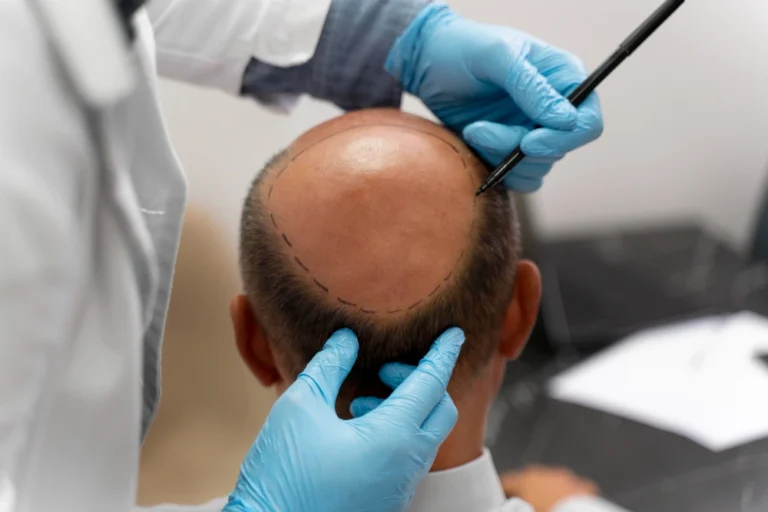
A medical procedure that moves permanent hairs (usually from the back and sides of the head) to thinning or balding areas. Techniques include FUT and FUE. A transplant does not stop ongoing hair loss in non-transplanted areas, so medical therapy is often recommended alongside surgery (see References: NHS/ISHRS).
Robotic FUE / motorised extraction
The use of robotic or motorised devices to assist with FUE punch scoring and harvesting. These tools can help with speed and consistency, but they do not replace a surgeon’s diagnosis, planning or overall supervision. Marketing should never suggest that a machine alone can deliver “scarless”, risk-free results.
Donor Anatomy & Hair Characteristics
Donor area
The region at the back and sides of the scalp that tends to retain hair throughout life. Grafts harvested from here are moved to thinning or balding areas during FUT or FUE (see References: ISHRS).
Graft (follicular unit graft)
A small piece of tissue containing one or more hair follicles. When people talk about “2,000 grafts”, they mean 2,000 of these units, not individual hairs. Each graft may contain 1–4 hairs. Pricing and planning often use graft counts as the main metric.
Hair calibre
The thickness of each hair shaft. Coarser (thicker) hair can create the appearance of more density than fine hair, even with the same number of grafts.
Hair density
How many hairs or grafts are present per square centimetre of scalp. Surgeons consider existing density, target cosmetic density and safe limits when planning a transplant.
Hair follicle and bulb (club hair)
A hair follicle is the tiny organ in the skin that produces each hair. At the base of the follicle is the hair bulb, which surrounds the dermal papilla (blood and growth-signal supply for the hair).
A club hair is a fully formed hair that has reached the end of its cycle and is ready to shed. When it falls out, you often see a small white or clear “club” at one end. Seeing occasional club hairs is normal; a sudden surge in these hairs can signal telogen effluvium or other forms of increased shedding.
Hair shaft
The hair shaft is the visible part of the hair that grows out above the surface of the skin. It is made of dead, keratinised cells and has three main layers: the cuticle (outer protective layer), the cortex (gives strength, colour and shape) and, in some hairs, a central medulla.
Most cosmetic damage—such as split ends, frizz, rough texture and breakage—happens to the hair shaft, not the follicle under the skin. Heat, bleaching, rough brushing and build-up all act on the shaft. This is why gentle hair care and protection from friction and high heat can reduce breakage even if the underlying cause of hair loss is separate.
Miniaturisation
The process in androgenetic alopecia where hairs become progressively finer, shorter and less pigmented. Miniaturised hairs often signal active genetic hair loss and influence whether surgery is appropriate or whether medical therapy should come first (see References: NHS/ISHRS).
Recipient area
The recipient area is the part of the scalp (or beard/other region) where hair grafts are implanted during a transplant.
It is usually the thinning or balding zone that needs more coverage and density. After surgery, the recipient area requires very careful aftercare — gentle washing, protection from friction, sun and trauma — so newly implanted grafts can survive and grow.
Safe donor zone
The part of the donor area most unlikely to thin with age. Skilled surgeons plan extractions within this zone, and space FUE punches carefully, to avoid patchy or see-through donor areas later. Overharvesting outside the safe zone can create visible thinness.
Hair Care & Products
Clarifying shampoo
A clarifying shampoo is a stronger cleanser designed to remove product build-up, excess oils and residue from the hair and sometimes the scalp. It is especially useful if you use a lot of styling products, heavy conditioners or live in an area with hard water.
Clarifying shampoos should usually be used occasionally (for example, once every 1–4 weeks) rather than every wash, to avoid drying out the hair. After clarifying, it is often helpful to follow with a moisturising conditioner on the lengths and ends.
Chelation (chelating)
Chelation in hair care refers to using products that bind to and help remove mineral deposits from hard water (such as calcium and magnesium) that can build up on the hair and make it feel rough, dull or coated.
Chelating shampoos or treatments are stronger than standard clarifying shampoos and are particularly helpful for people with hard water or swimmers exposed to chlorine. Because they can be drying, they are usually used occasionally and followed by a hydrating conditioner, focusing on the mid-lengths and ends rather than the scalp.
Planning, Design & Outcomes
Density (grafts per cm²)
A planning number describing how many grafts will be placed in a given area of the scalp. Surgical density is usually lower than natural, undisturbed density to preserve blood supply and graft survival. The goal is a natural-looking illusion of fullness, not “teenage density” everywhere (see References: ISHRS).
Graft survival rate
The percentage of transplanted grafts that successfully grow long term. Good technique, gentle handling, proper storage, realistic graft numbers and careful aftercare all affect survival. For a deeper dive, see Graft Survival Rates: What Affects Outcomes
Hairline design
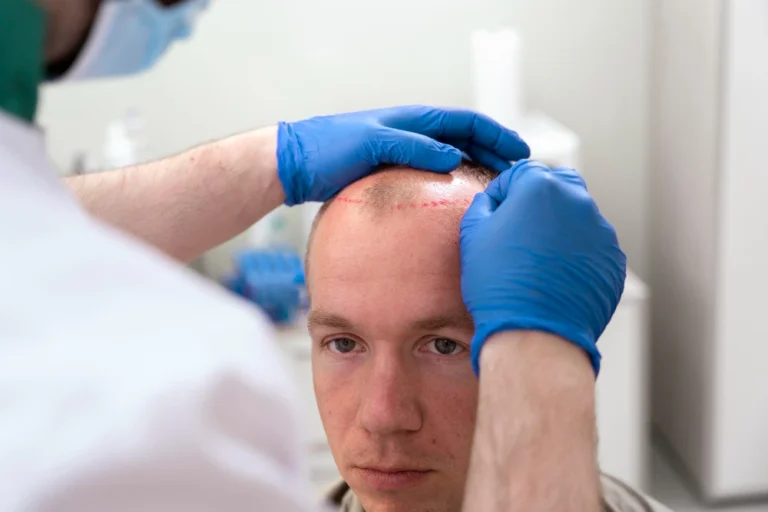
The shape, height and pattern of your transplanted hairline. A good design is age-appropriate, accounts for future loss, and suits your facial features, hair calibre and curl. Overly low or dense hairlines can look unnatural and use too many grafts early in life.
Norwood scale
A classification system for male pattern baldness (androgenetic alopecia), ranging from minimal recession to extensive hair loss. It helps describe how advanced your hair loss is and what may be achievable with surgery and medical treatments.
Single-session graft count
How many grafts can be safely transplanted in one day. This depends on the method (FUE vs FUT), team size, surgeon involvement, your donor characteristics and safety considerations. Very high numbers in a single sitting can be risky if not planned and executed carefully.
Complications & Risks
Infection / bleeding / numbness
General surgical risks that can occur around donor and recipient sites. They are uncommon when clinics follow proper sterile technique and aftercare, but they must be explained in advance as part of informed consent (see References: NHS).
Overharvesting
Removing too many grafts from the donor area, or taking them from regions likely to thin in future. Overharvesting can lead to visible thinning, patchiness or a “moth-eaten” donor look. Careful mapping and conservative planning reduce this risk.
Scarring (dot vs linear)
All surgical hair transplant methods produce scars.
- FUE leaves multiple tiny dot scars where each punch entered.
- FUT leaves a single linear scar at the donor incision.
- Scar visibility depends on technique, your healing, and your chosen hairstyle (see References: ISHRS).
Shock loss
Temporary shedding of native hair around the transplant site after surgery. This often affects miniaturised hairs and usually regrows over several months, but it can be upsetting while it is happening. Your surgeon should discuss this risk before you consent. For more detail, see Shock Loss vs Normal Shedding After Transplant.
Transection
Cutting or damaging hair follicles during extraction or incision, which reduces the chance that a graft will survive. Good tools, proper angles and experienced surgeons help minimise transection.
Medications & Non-Surgical Therapies
Always discuss medications and treatments with a qualified clinician; this glossary does not recommend specific treatments (see References: NHS/ISHRS).
Finasteride
A medication that lowers levels of dihydrotestosterone (DHT), often used to treat male pattern hair loss. It can help slow or stabilise loss in many men. Benefits and potential side effects should be reviewed with a doctor who knows your medical history.
Hair systems
Hair systems (also called hairpieces, toupees or non-surgical replacements) are customised units made of hair and a base material that are attached to the scalp with adhesives, clips or integration methods. Unlike a transplant, they do not move your own follicles; they sit on top of the scalp.
High-quality hair systems can look very natural, but they require regular maintenance: adhesive changes, careful cleaning, professional refits and periodic replacement of the unit. They can be a good option for advanced hair loss or for people who are not candidates for surgery or medical treatment, as long as users commit to proper scalp care and follow-up.
Low-level laser therapy (LLLT)
Light-based devices (helmets, caps, combs) designed to stimulate hair follicles. Evidence suggests some patients may see benefits when used consistently, but results are usually more modest than with core medications and it is best viewed as an adjunct.
Minoxidil
A topical or oral medication that can prolong the growth phase of hair and increase hair shaft diameter for some users. Used in both men and women to slow hair loss or support regrowth.
Non-surgical hair restoration
An umbrella term for medications, topical treatments, devices and lifestyle changes used to slow or partly reverse hair loss without surgery. For a structured overview, see Effective Non-Surgical Hair Restoration Methods.
Platelet-rich plasma (PRP)
An injectable treatment where concentrated platelets from your own blood are introduced into the scalp. Evidence is mixed, but some patients may benefit when PRP is used alongside other therapies. Protocols vary by clinic (see References: ISHRS/BAHRS).
Scalp Micropigmentation (SMP)
Scalp micropigmentation (SMP) is a non-surgical cosmetic procedure that uses tiny dots of pigment to mimic shaved hair or add the illusion of density. It does not regrow hair; it improves how thin or bald areas look.
SMP can be useful for people who wear short styles, want to camouflage scars (for example, FUT strip scars) or reduce the contrast between hair and scalp in diffuse thinning. Results usually last several years but need touch-ups over time. It should be done by trained practitioners, and active inflammatory scalp disease should be ruled out or stabilised first.
Credentials, Clinics & Regulation
ABHRS (American Board of Hair Restoration Surgery)
A certification body that examines and recognises doctors with specific training and experience in hair restoration. “ABHRS Diplomate” status is one credential you can look for when assessing surgeon focus and education (see References: ABHRS).
BAHRS (British Association of Hair Restoration Surgery)
A UK-based professional organisation that sets professional guidance and offers patient advice, including warnings about surgery abroad and technician-led models.
CQC (Care Quality Commission)
The regulator for health and social care services in England. Independent clinics and hospitals performing cosmetic surgery (including hair transplant) must be registered with the CQC. Patients can search the register to confirm a clinic’s status (see References: CQC/NHS).
Hair transplant surgeon
A licensed doctor who performs hair transplant surgery. Ideally, they have focused training in hair restoration, perform a substantial number of cases per year, and are transparent about complication rates and outcomes. See Before You Choose a Hair Transplant Surgeon.
ISHRS (International Society of Hair Restoration Surgery)
A global professional society focused on education and standards in hair restoration. Membership signals interest and engagement but is not, by itself, proof of skill. ISHRS also provides consumer warnings and a “Find a Doctor” tool (see References: ISHRS).
National medical council / licensing board
Authorities that licence doctors to practise medicine in a given country (for example, GMC in the UK). These registers allow you to verify that a doctor is licensed and to check for fitness-to-practise issues.
NHS
NHS stands for the National Health Service, the publicly funded healthcare system in the United Kingdom.
In the context of hair transplants, the NHS is mainly relevant as an independent source of patient information about surgery risks, recovery, scarring and when to seek medical help. Most hair transplant procedures are not covered by the NHS because they are considered cosmetic, but its patient guides are useful for setting realistic expectations about safety and outcomes.
Technician (surgical assistant)
Trained staff who support the doctor during surgery by preparing instruments, handling and placing grafts, and assisting with documentation, within the legal scope of practice in that country. Technicians should not replace a doctor for diagnosis, planning, incisions or donor harvesting (see References: ISHRS/BAHRS).
Diagnosis & Hair Loss Patterns
Alopecia areata
An autoimmune condition in which the immune system attacks hair follicles, leading to patchy hair loss on the scalp or body. Patches can appear suddenly and may regrow or recur. Because alopecia areata behaves very differently from androgenetic alopecia, it needs specialist assessment, and hair transplant surgery is often not the first-line option.
Androgenetic alopecia
The most common inherited form of hair loss in men and women. In androgenetic alopecia, hairs gradually miniaturise — becoming finer, shorter and less pigmented over time — usually in a recognisable pattern (such as receding temples or thinning over the crown). It often stabilises or improves with evidence-based medical treatments but usually does not reverse completely on its own. Understanding whether your hair loss is androgenetic or something else is a key step before considering a hair transplant.
Traction alopecia
Traction alopecia is hair loss caused by chronic tension on the hair, usually from tight hairstyles such as tight ponytails, braids, extensions, locs, tight turbans or strong clipping systems.
In early stages, hair often regrows once the pulling stops and styles are changed. If traction continues for years, the follicles can become permanently damaged and scarring hair loss may develop. Because of this, switching to looser styles as soon as possible is essential to protect long-term density at the hairline and temples.
Diagnosis & Hair Loss Patterns
Dandruff
Dandruff is a very common scalp condition that causes flakes and mild itch. It is usually related to an overgrowth of Malassezia yeast on the scalp and an inflammatory response in the skin.
On its own, dandruff does not usually cause scarring hair loss, but ongoing inflammation and scratching can make shedding more noticeable. Anti-dandruff shampoos with active ingredients such as ketoconazole, zinc pyrithione or salicylic acid often help when used regularly and left on the scalp for a few minutes before rinsing.
Dermoscopy
Dermoscopy (or dermatoscopy) is a way of examining the skin and scalp using a handheld device with magnification and polarised light. It lets the clinician see structures under the surface that are not visible to the naked eye.
In hair loss, scalp dermoscopy helps differentiate between conditions such as androgenetic alopecia, telogen effluvium, alopecia areata and scarring alopecias. It is a key part of a proper hair loss diagnosis and can guide which blood tests or treatments make sense next.
Ferritin (iron stores)
Ferritin is a protein that stores iron in your body and releases it when needed. A ferritin blood test is often used as a marker of your iron stores, rather than just the iron floating in your bloodstream on the day of the test.
In the context of hair loss, low ferritin is a recognised contributor to diffuse shedding, especially in people who menstruate, after pregnancy or with restrictive diets. When ferritin is low, the body may prioritise vital organs over hair, pushing more follicles into the shedding phase.
If you suspect iron deficiency or ongoing shedding, speak with your doctor about appropriate blood tests and treatment. Avoid starting high-dose iron supplements on your own, as excess iron can be harmful and needs medical supervision.
PCOS (polycystic ovary syndrome)
A hormonal condition that affects some women and can cause irregular periods, acne, weight changes and higher levels of androgens (“male” hormones). PCOS itself is not a hair disease, but the hormonal imbalance can lead to increased shedding on the scalp and extra hair growth on the face or body. If PCOS is suspected, hair loss should be assessed together with a gynaecologist or endocrinologist as well as a hair specialist.
Seborrheic dermatitis
Seborrheic dermatitis is a more inflamed form of dandruff that can cause redness, greasy scale and itch on the scalp, eyebrows and other oily areas. It is also linked to Malassezia yeast and a sensitive immune response.
In hair loss, seborrheic dermatitis can contribute to increased shedding by irritating the scalp and making existing issues (such as androgenetic alopecia) look worse. Treatment usually involves medicated shampoos and, in some cases, topical anti-inflammatory or antifungal medicines prescribed by a clinician.
Telogen effluvium
A type of temporary hair shedding where a larger number of hairs than usual enter the resting (telogen) phase and then fall out. It can be triggered by stress, illness, surgery, nutritional issues or hormonal changes. Telogen effluvium usually causes diffuse shedding rather than clear bald patches and often improves once the trigger is addressed.
Thyroid disease and hair loss
Both underactive and overactive thyroid conditions can contribute to diffuse hair thinning or increased shedding. Thyroid-related hair loss usually improves once hormone levels are corrected, but it can overlap with other types of hair loss such as androgenetic alopecia. Blood tests and medical assessment are needed to confirm or rule out thyroid causes.
Hair Enhancement Resources & Guides
- How to Choose a Hair Transplant Clinic — Licensing checks, red flags, and consultation steps to compare clinics safely.
- Before You Choose a Hair Transplant Surgeon — Doctor vs technician roles, credentials and the questions to ask before surgery.
- FUE vs FUT Hair Transplant: Which Method Is Right for You? — Techniques, scars, recovery, costs and long-term donor strategy compared side by side.
- Effective Non-Surgical Hair Restoration Methods — Evidence-based medications and therapies to stabilise hair loss before or alongside surgery.
- Hair Transplant Recovery Timeline — A week-by-week overview of healing, shedding and regrowth after surgery.
FAQs – Hair Transplant Glossary
Explore Related Questions
- How do I choose a safe hair transplant clinic using this terminology?
- What should I ask a surgeon once I understand these terms?
- Which non-surgical options should I learn about before surgery?
Found this helpful? Share it in your hair-loss or transplant research group so more people can understand the language and make informed decisions.
References
- NHS — Hair Transplant (Patient Guide)
- NHS — Cosmetic Procedures: Choosing Who Will Do Your Procedure
- ISHRS — Surgical Treatments for Hair Loss
- ISHRS — FUE vs FUT and Maximizing the Hair Graft Harvest
- ISHRS — Donor Area in Hair Transplant Surgery
- ISHRS — Treatments for Hair Loss (Overview)
- ISHRS — Consumer Alert: Unlicensed Personnel & False Advertising
- ISHRS — Find a Doctor (Hair Restoration Physicians)
- BAHRS — Patient Advice
- BAHRS — Advice to Patients Considering Having Hair Transplant Surgery Abroad (PDF)
- ABHRS — Why ABHRS Certification Matters
- CQC — Choosing Cosmetic Surgery (How to Check if a Clinic Is Registered)
- GMC — Search the UK Medical Registers (Check a Doctor’s Registration)
Medical Disclaimer: The content on hairimplants.net is for informational purposes only and should not be considered medical advice. It does not replace a professional medical consultation, diagnosis, or treatment. Readers are encouraged to seek guidance from a qualified healthcare provider before making any decisions about hair restoration treatments. Hairimplants.net accepts no liability for actions taken based on the information provided.
Affiliate Disclosure: Hairimplants.net may contain affiliate links. If you click a link and make a purchase, we may earn a small commission at no additional cost to you. This helps us keep our content free and research-based. Our editorial opinions are independent and not influenced by partnerships. We do not accept payment for favorable reviews or rankings. Links to medical sources are non-affiliate.