Reading time: 8 min.
When transplants aren’t possible (poor donor, medical reasons, timeline, or budget), the big choice becomes scalp micropigmentation vs hair system. This guide compares realism, upkeep, skin health, costs, and lifestyle fit—so you can pick an option you’ll be happy living with day-to-day.
Know someone comparing SMP with non-surgical hair systems? Share this guide.
At a Glance
Hair systems add real/artificial hair for instant coverage and styling freedom—but need salon maintenance and adhesives.
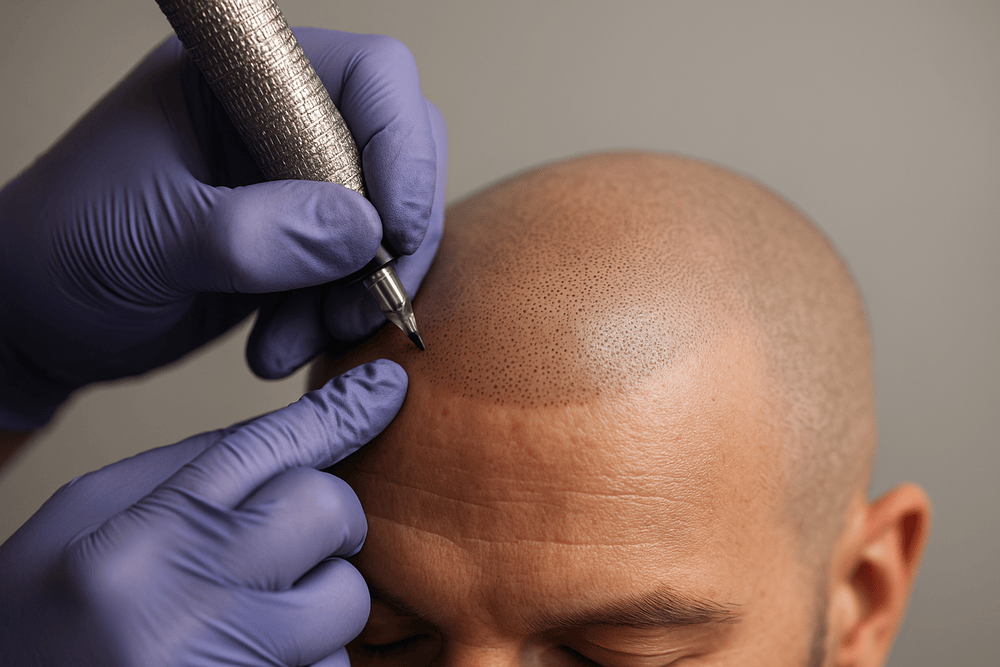
SMP is medical-style tattooing that simulates stubble/density—ultra-low maintenance but offers no length.
Systems can look exceptionally natural in photoshoots; the tell is long-term upkeep, adhesives, and hairline blending.
SMP shines for shaved or very short styles, scar camouflage, and diffuse thinning “densification.”
Both are non-medical; results depend more on provider skill and aftercare than on brand names.
See also: Non-Surgical Hair Restoration • Minoxidil Guide • Oral vs Topical Finasteride • Best Laser Cap • Hair Systems & Scalp Micropigmentation • PRP For Hair Loss: Sessions, Costs & Results
What Each Option Actually Is
Hair systems (non-surgical hair replacement): a base (lace/skin/hybrid) bonded to the scalp; human or synthetic hair is knotted or injected into the base, then cut and blended to your style.
Scalp micropigmentation (SMP): point-by-point implantation of pigment at controlled depth to mimic follicles or add the illusion of density through “negative space.”
Both are camouflage, not medical treatment. For medical and hormonal causes you may still want a work-up: Hormonal & Health-Related Causes of Hair Loss (What to Check First)
Smart Tip: Decide your default haircut first. If you love a buzzed look, SMP fits. If you want length and movement, a hair system fits.
Pros & Cons Side-by-Side
Hair Systems (Units, Toppers, Toupees)
Pros
- Immediate transformation with real hair length, texture, and parting.
- Fully customizable hairlines, curls, density, and color.
- Reversible—remove if you don’t like it.
Cons
- Ongoing maintenance (re-bonds every 2–4 weeks; base replacement every few months depending on lifestyle).
- Adhesives/sweat can irritate sensitive scalps; hygiene matters.
- Sports, saunas, ocean swims, and high-heat styling require extra care and realistic expectations.
- Long-term costs can exceed surgical routes.
Scalp Micropigmentation (SMP)
Pros
- Low day-to-day maintenance once healed; no adhesives.
- Great for shaved styles, hairline framing, scar camouflage after FUT/FUE, and density for diffuse thinning.
- Sweat- and gym-friendly; results don’t “lift.”
- Touch-ups every 2–4 years for most people.
Cons
- No actual hair length—works best with buzzed cuts for full baldness.
- Color shift or migration if performed poorly; sun protection matters.
- Laser/light removal is possible but time-consuming if you regret design or color.
Smart Tip: Ask SMP artists for healed photos under daylight and videos while the client moves. Fresh, just-done dots look sharper than the healed reality.
Who Is a Good Candidate?
- Choose a Hair System if you: want longer hairstyles, have major diffuse loss or Norwood 5–7 but prefer hair length, or need a reversible, fast transformation for work/media.
- Choose SMP if you: are comfortable with a clipper-short style, want to de-shine the scalp, improve hairline framing, or camouflage a donor/strip scar.
- Combo approach: some clients wear a thin system with SMP as a “shadow” for depth, so shedding between refits is less obvious.
If you’re still comparing transplant paths, read: FUE vs FUT Hair Transplant: Which Method Is Right for You?
Skin, Hygiene & Aftercare
Hair Systems
- Cleanse the scalp thoroughly at each re-bond; rotate adhesives/solvents as advised to avoid dermatitis.
- Keep a realistic wear schedule: lace bases breathe better; ultra-thin “skin” bases look sharp but are less durable.
- Build a gentle scalp routine to avoid folliculitis: What Is the Best Daily Scalp Care Routine For Hair Growth? (Dermatologist-Aligned)
SMP
- Expect a multi-session process (usually 2–4). Heal with mild cleansing, avoid heavy sweat/sun for a few days, then SPF every day.
- Choose pigments formulated for SMP with predictable fade; avoid body-tattoo inks for scalp work.
- If you plan future transplant work, tell your SMP provider—designs should respect potential donor/recipient planning.
Smart Tip: Patch-test adhesives (systems) and discuss pigment ingredients (SMP) if you have a history of contact dermatitis or sensitive skin.
Realism & Aesthetics
- Systems: realism hinges on hairline ventilation (single knots/bleached knots), base translucency, and a cut that suits your density and face shape. The most convincing systems are slightly under-dense at the front.
- SMP: realism depends on dot size, dispersion, and color temperature. The goal is soft gradients and irregularity that mimic nature—not rows of identical dots.
Cost & Time Over 2–3 Years (Typical Ranges)
- Hair system: unit(s) + salon refits + products can total mid- to high-four figures annually depending on quality and frequency.
- SMP: a complete course is typically one mid-four-figure payment with light touch-ups years later.
- Actual prices vary by region and provider; compare total cost of ownership, not just the first visit.
For a broader non-surgical plan (minoxidil, LLLT, etc.), see: Non-Surgical Hair Restoration: Your Guide to What Actually Works
How To Choose a Provider (Checklist)
Hair Systems
- See install + cut-in footage, not just studio photos.
- Ask about base types (lace, skin, hybrid), densities, and typical lifespan.
- Confirm hygiene protocol and re-bond cadence; request a total-cost estimate for 12 months.
SMP
- Review healed work in bright natural light; ask for color-fade examples at 6–12 months.
- Confirm medical-grade hygiene, single-use needles, depth control, and pigment brand.
- Hairline design trial with a washable pencil before inking.
Smart Tip: Avoid long contracts and grand promises. Pay per milestone (consult, test patch, first session, follow-ups) and keep an exit route.
Red Flags
- “Undetectable in any situation” claims.
- No mention of maintenance schedule (systems) or fade/touch-ups (SMP).
- Reluctance to show healed results or to discuss complications.
- High-pressure sales or multi-year contracts.
Hair Restoration Resources & Guides
- Non-surgical stacks that work in real life: Non-Surgical Hair Restoration: Your Guide to What Actually Works
- Everyday scalp care that supports device use: What Is the Best Daily Scalp Care Routine For Hair Growth? (Dermatologist-Aligned)
- Check common causes first so you’re treating the right thing: Why Am I Losing Hair? The Most Common Causes of Hair Loss
FAQ
See Top-Rated Clinics
Prefer a diagnosis-first approach? Browse neutral, vetted clinics that manage genetic hair loss with medical therapy (and surgery if needed). Filter by credentials, outcomes, and follow-up care. → See top-rated clinics
Conclusion
Choosing between scalp micropigmentation vs hair system comes down to lifestyle, haircut preference, and maintenance tolerance. Systems deliver instant hair length but require regular upkeep; SMP offers a low-maintenance stubble illusion that excels with short styles. Try consultations for both, then pick the option you can live with confidently every day.
Found this helpful? Share it in your hair-loss or transplant research group so more people make informed decisions.
References
- American Academy of Dermatology – Hair loss: Diagnosis & treatment
- American Academy of Dermatology – Hair Loss Resource Center
- ISHRS – Patients: Male Hair Loss (education hub)
- ISHRS – Treatments for Hair Loss in Men (surgical & non-surgical overview)
- NHS – Wigs and fabric supports on the NHS (custos/critérios)
- BNSSG NHS – Wigs, Hairpieces and Hair Replacement Systems (policy PDF)
- Annals of Dermatology (2024) – Perceptions and Experiences of Scalp Micropigmentation
- Rassman et al., 2015 – Scalp Micropigmentation: A Concealer for Hair and Scalp Deformities (PMC)
- Nguyen et al., 2022 – Scalp Micropigmentation: A Clinicopathologic Correlation (PMC)
- Kerure et al., 2023 – Micropigmentation (review; techniques & safety) (PMC)
- Mayo Clinic – Hair loss: Diagnosis & treatment (overview para leigos)
Medical Disclaimer: The content on hairimplants.net is for informational purposes only and should not be considered medical advice. It does not replace a professional medical consultation, diagnosis, or treatment. Readers are encouraged to seek guidance from a qualified healthcare provider before making any decisions about hair restoration treatments. Hairimplants.net accepts no liability for actions taken based on the information provided.
Affiliate Disclosure: Hairimplants.net may contain affiliate links. If you click a link and make a purchase, we may earn a small commission at no additional cost to you. This helps us keep our content free and research-based. Our editorial opinions are independent and not influenced by partnerships. We do not accept payment for favorable reviews or rankings. Links to medical sources are non-affiliate.