Reading time: 7 min.
Looking for the best laser cap for hair growth but overwhelmed by claims, wavelengths, and diode counts? This clear, evidence-based guide explains how LLLT (low-level light therapy) works, the specs that actually matter, what “FDA-cleared” really means, and how to pick a device you’ll use consistently—without overpaying.
Know someone eyeing a laser cap? Share this guide.
At a Glance
LLLT can improve hair counts vs sham in men and women with pattern hair loss; outcomes depend on consistent use.
Core specs to check: red light (typically ~650 nm), verified irradiance/coverage, session time, and build that encourages adherence.
“FDA-cleared” (510(k)) ≠ “proven best”—it means substantially equivalent to a predicate device for safety/indications.
Expect gradual change: first assessment at 3–6 months; clearer verdict by ~12 months, often best as part of a stack (minoxidil ± finasteride, case-by-case).
Combine smartly: LLLT may add benefit to minoxidil in some studies; clinic-grade routines or microneedling can complement it.
See also: Non-Surgical Hair Restoration • Minoxidil Guide • Oral vs Topical Finasteride • Best Laser Cap • Hair Systems & Scalp Micropigmentation • PRP For Hair Loss: Sessions, Costs & Results
What LLLT Actually Does
LLLT delivers low-energy red light to the scalp to nudge follicles toward growth (anagen) and improve hair counts vs placebo in pattern hair loss. Meta-analyses of FDA-cleared home devices show modest but meaningful gains when users stick to the protocol.
Smart Tip: Treat LLLT like brushing your teeth—schedule fixed sessions and set reminders. Results hinge on adherence, not diode marketing.
The Specs That Matter (And Why)
Wavelength & Light Source
Most cleared devices use red diodes around 650 nm; some mix lasers and LEDs. Don’t obsess over tiny wavelength differences—consistency and adequate coverage beat spec-sheet hair-splitting.
Coverage & Irradiance
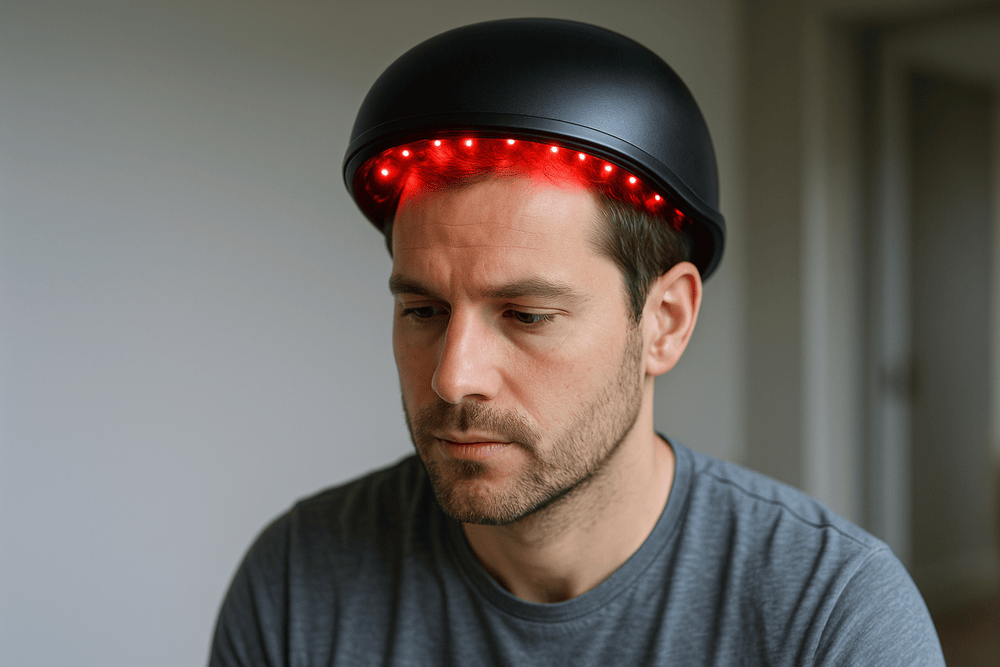
Look for dome/cap designs that cover hairline, mid-scalp, and crown with even distribution. Reputable makers disclose diode count and arrangement; some also share mW/cm² at the scalp (ideal). More diodes can improve coverage, but the goal is uniform dosing rather than a raw “number race.”
Session Time & Frequency
Common regimens range from 6 minutes daily to ~30 minutes every other day, depending on the model. Shorter, truly hands-free sessions improve real-world use.
Build, Fit & Usability
Caps you can wear while reading/working beat combs you must move for 10–15 minutes. Comfort, ventilation, and a reliable timer matter—because you’ll repeat this hundreds of times.
Smart Tip: Before you buy, ask for the official 510(k) number and the device’s user protocol in writing. If the brand can’t provide both, look elsewhere.
“FDA-Cleared” vs “FDA-Approved”: What It Really Means
Most home laser caps are FDA-cleared (510(k)), meaning they’re substantially equivalent to a predicate device for treating androgenetic alopecia—not that they’ve proven superiority over other caps. Examples include classic combs and dome/cap systems with red laser diodes around 650 nm. Use 510(k) clearance as a minimum bar, not a tie-breaker for “best.”
Who Benefits Most (And Who Should Skip)
- Best candidates: early-to-moderate pattern hair loss, or anyone building a non-surgical routine they can sustain. LLLT is also considered as an adjunct after stress-related shedding once triggers are addressed.
- Manage expectations: LLLT is typically additive, not a standalone “cure.” Pair with pharmacologic therapy where appropriate. See our stack builder: Non-Surgical Hair Restoration: Your Guide to What Actually Works
- Skip or get medical guidance first: unclear diagnosis (scarring alopecias, rapid diffuse loss), pregnancy, light-sensitivity disorders, or scalp lesions—speak to a clinician.
How To Compare Real Devices (A Practical Checklist)
- Verify 510(k) clearance (brand + model). Keep the K-number.
- Check wavelength & distribution (~650 nm red; full-scalp coverage).
- Session plan (≤10 minutes daily or ~20–30 minutes QOD) you can sustain.
- Return policy & warranty (many offer 6–12 months).
- Evidence & transparency (published data or at least specs + dosing).
Smart Tip: Don’t overpay for “LED + laser” mixes unless the protocol is easier or coverage is better. Your scalp can’t benefit from specs you don’t actually use.
Safety, Side Effects & Sensible Use
LLLT is generally well-tolerated; reported issues are usually mild (warmth, transient scalp tingling). The American Academy of Dermatology lists laser therapy as an option for hereditary hair loss—particularly for patients avoiding or supplementing meds. As with any device, avoid staring into diodes, follow the schedule, and keep scalp skin healthy.
Results Timeline & Combining With Other Treatments
Plan on 3–6 months for visible change and a 12-month verdict. Pairing LLLT with topical minoxidil can improve density metrics in some studies, and stacking with evidence-based medications (men: finasteride; women: clinician-guided options) often enhances maintenance.
- Minoxidil formulation tips: Minoxidil: Foam or Solution? A Complete Guide for Men and Women
- Build your prevention routine: How to Build a Daily Routine That Actually Prevents Hair Loss
- Considering microneedling with topicals? Does Microneedling for Hair Loss Actually Work? What the Science Says
Value for Money: What “Best” Looks Like
The best laser cap is the one that is (1) cleared, (2) covers your scalp evenly, (3) fits a manageable schedule, and (4) integrates into a broader plan. Don’t chase maximum diodes if it means 30-minute sessions you’ll skip. Instead, pick the simplest path to perfect adherence.
Hair Restoration Resources & Guides
- Non-surgical stacks that work in real life: Non-Surgical Hair Restoration: Your Guide to What Actually Works
- Everyday scalp care that supports device use: What Is the Best Daily Scalp Care Routine For Hair Growth? (Dermatologist-Aligned)
- Check common causes first so you’re treating the right thing: Why Am I Losing Hair? The Most Common Causes of Hair Loss
FAQ
See Top-Rated Clinics
Prefer a diagnosis-first approach? Browse neutral, vetted clinics that manage genetic hair loss with medical therapy (and surgery if needed). Filter by credentials, outcomes, and follow-up care. → See top-rated clinics
Conclusion
If you remember one thing from this best laser cap guide: choose a 510(k)-cleared device with full-scalp coverage and a session time you’ll actually stick to—then give it 6–12 months within a sensible, clinician-guided routine.
Found this helpful? Share it in your hair-loss or transplant research group so more people make informed decisions.
References
- AAD – Hair Loss: Diagnosis & Treatment (laser therapy overview)
- FDA 510(k) – HairMax LaserComb K093499 (clearance details)
- FDA 510(k) – Capillus Laser Domes K163170 (indications, 650 nm diodes)
- Systematic Review & Meta-analysis of FDA-Approved Home-Use LLLT Devices (JCAD, 2021)
- Narrative Review: Role of Low-Level Light/Laser Therapy in AGA (2021)
- Recent Systematic Review (2024) – LLLT for MPHL/FPHL
- Clinical Signal: LLLT + Minoxidil Improves Density (JAAD abstract, 2025)
Medical Disclaimer: The content on hairimplants.net is for informational purposes only and should not be considered medical advice. It does not replace a professional medical consultation, diagnosis, or treatment. Readers are encouraged to seek guidance from a qualified healthcare provider before making any decisions about hair restoration treatments. Hairimplants.net accepts no liability for actions taken based on the information provided.
Affiliate Disclosure: Hairimplants.net may contain affiliate links. If you click a link and make a purchase, we may earn a small commission at no additional cost to you. This helps us keep our content free and research-based. Our editorial opinions are independent and not influenced by partnerships. We do not accept payment for favorable reviews or rankings. Links to medical sources are non-affiliate.